


URA Enforcement Teams Arrest Two over US$24,000 Super Match Cigarette Export Scam
December 5, 2025Office of the DPP Hosts Community Baraza in Tororo Municipality
December 9, 2025
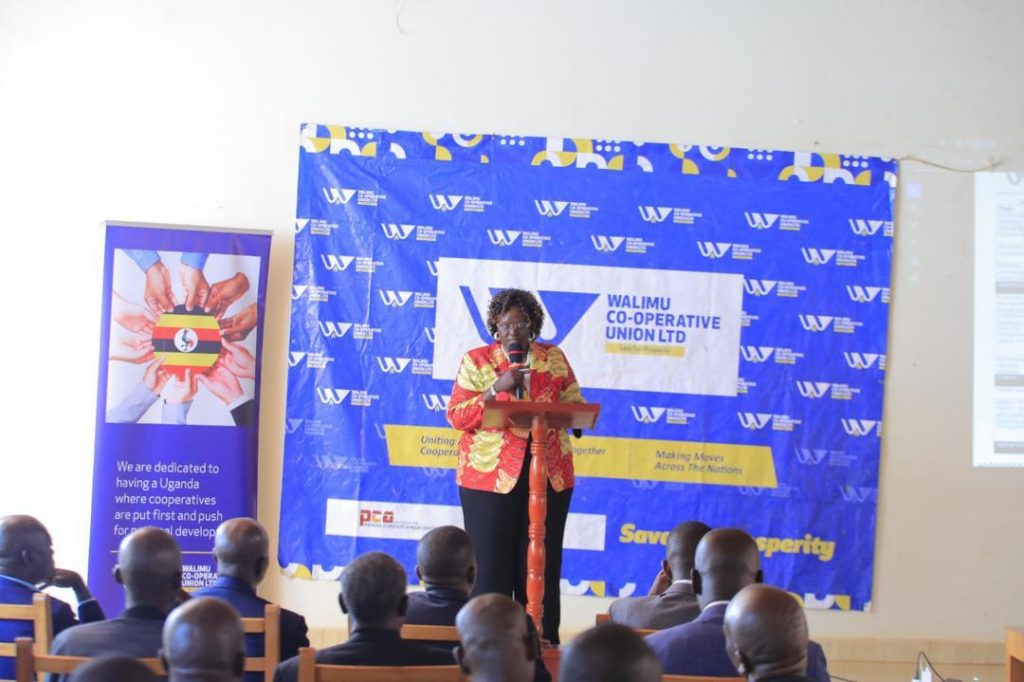
Walimu Cooperative Union Ltd – a saving scheme where teachers can borrow money at a low rate, has started sensitizing teachers across the country on mass enterprise production as a way of enhancing teachers’ welfare. The Chairperson Walimu Cooperative Union Ltd, Stephen Nabende is very optimistic that if teachers are equipped with enough entrepreneurship skills, they will positively impact on the money economy by taking part in enterprise production. He made the remarks during a- one day retreat attended by leaders of Teacher SACCOs from 100 selected districts across the country held at Namugongo Kyoto Catholic church in Wakiso district.
Stephen Nabende noted that previously teachers have been relying on monthly salary which is not all that sustainable but as Walimu they believe that besides teaching, teachers should be able to contribute to the money economy by engaging in mass enterprise production.
” Teachers should venture in income generating projects which can generate revenue for the government. Then the government can use the revenue generated from teachers’ projects to invest in schools and other community projects, ” Mr.Nabende explained.

‘ To achieve this, we have developed an approach where we shall collaborate with district officials like the Chief Administrative officer, Commercial officer among others so that we train our teachers to run their business ventures effectively without incurring losses.
‘ The commercial officer will monitor teachers’ projects to ensure there is sustainability and he/she will help in marketing teachers’ products.’
Nabende outlined the three ways in which the enterprise production model would help the teachers’ SACCO achieve success: ” Initially teachers would run individual projects hence it was difficult for us to monitor such projects,” said Nabende.
‘ A teacher would borrow money from the SACCO purporting to start a business but in reality, uses the money to pay school fees for his or her children.This became hard for us to monitor. But under the new enterprise model, schools will come up with a particular project and all teachers must participate in it. By doing so, it would be easier for us to monitor the project. For instance, the permanent secretary in ministry of education can easily visit particular schools to establish the projects they are involved in, ” Mr.Nabende explained.
‘ Secondly, with the enterprise model -we shall see how best we can utilize school infrastructures especially during holidays when learners are away. We need to make the classrooms productive and we shall design projects like poultry farming and animal keeping to train learners how to manage them.
‘ Thirdly, we also intend to utilize idle school land. We shall task teachers to fully utilize the idle school land to make it more productive.
‘ So those are the areas we shall focus on to ensure our teachers are more productive than before, ” Nabende expressed optimism.’
The Chairperson of the review committee of Walimu Cooperative Union , Teopista Birungi Mayanja , said 10 years down the road, the teachers’ SACCO has been looked at as teachers economic strategy that enables teachers settle in class, teach learners and also for teachers to live a status in society when they have some money. She, however revealed that years later gaps have emerged in the teachers’ SACCO because there are no success stories to tell.
She said given those gaps; they have now embarked on serious production through enterprise projects.

” Teachers have been borrowing money from the SACCO and spend it on unproductive things. But now we want to enhance the principles of cooperatives which include saving, buying shares and production.
‘ Now our focus is on multipurpose Cooperative society so that we are able to produce things like food and Mineral products among other things.
‘ We are engaging teachers across the country on our new strategy to improving their welfare and livelihood. In this strategy the emphasis is about teachers changing their mindset. For instance, instead of negotiating for salary enhancement with government, we want to be talking about having a fund of Shs150m in a year and we shall expect the government to double it.
‘ Remember the budget for the Ministry of education is big and 60% of it goes to teachers’ salary. This is a consumption budget and as Walimu we are thinking of how we can produce than being salary earners, ” Ms.Teopista Birungi explicitly explained the new teachers’ strategy.’
On the other hand, the General Manager Walimu Cooperative Union Ltd, Carolyn Atai Kiyai, said the new enterprise production model allows teachers within a particular district to agree with their leaders on what to produce.
” Teachers may agree on the enterprise to undertake for example some may decide to carryout poultry farming while others may choose cattle farming. Therefore, we shall help them brand their products depending on the district where they come from, “Atai stated.

‘ So far, there are already 10 established enterprises and indeed they’re faring well and majority of the teachers are involved in poultry farming and very soon their products will be out on the market, “Atai disclosed.
Atai also observed that in phase one they mainly focused on establishment of teachers SACCO at the district level and by the end of this phase they were able to establish 285 teachers SACCOS. She, however says in phase two they are focusing on Enterprise production and value addition.
Atai further cited misconception of the SACCO project and poor saving culture as the key challenges faced by Walimu Cooperative Teachers Union.
The Assistant Commissioner in charge of financial services at the Ministry of Finance Planning and Economic Development, Richard Ndyanabo, urged management of Walimu Cooperative Teachers Union Ltd to conform with Cooperative society Act and to strengthen SACCO governance and compliance on top of building strong institutional partnership.
