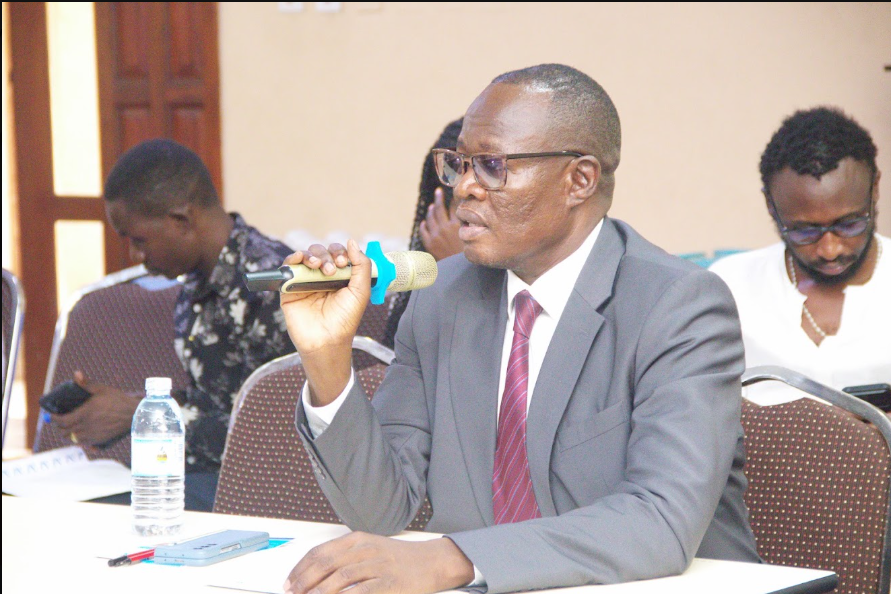
42-year old beheaded by unknown goons, head taken
May 4, 2019
Ssebulime died a reclusive man — bikers boss
May 4, 2019
By The Second Opinion Team
On March 24, 2019, Ronald Ssebulime was killed while on his way to visit his two daughters at St Andrew’s S.S in Kabimbiri, Mukono district. Since then however, his death has been an issue on national concern, particularly haunting two main parties. The first haunted lot is the Uganda police force, whose officers summarily executed Ssebulime in an extrajudicial shooting as they responded to a SOS call from Kayunga Woman MP and state minister for ICT, Idah Erios Nantaba — the second haunted party.
In retrospect, Ssebulime’s death echoes a call in which President Museveni advised motorists to ‘sort’ themselves with motorcyclists that they deemed suspicious or harmful to their lives.
However, it is imperative to note that the president did not advise for summary executions as it happened in Ssebulime’s case.
Why Ssebulime could have been killed?
Currently, police are going on with investigations into what exactly led to Ssebulime’s killing. The force’s paradox is however complicated by revelations that Ssebulime was pursued and arrested alive before an order from a yet unidentified “Above” dictated the he be killed despite him having been subdued and on handcuffs.
Following Ssebulime’s death, his family have since demande that nantaba compensates them for leading to the death of their son.
But in a stern reply to them, an adamant Nantaba assured the relatives that she will not pay a coin in compensation. She noted that her refusal is premised on her gut feeling that Ssebulime was not as innocent as the public is portraying him to be.
“It’s unfortunate Ssebulime died before giving me answers to questions that I still have about him. As Nantaba I wanted Ssebulime alive so I could know his intention towards my life. I also wanted to know who sent him among other questions,” Nantaba said, even referring the relatives to past incidents where prominent people were killed by elements that first trailed them on motorbikes.
Who wants nantaba dead?
Analyzing thius saga, seasoned investigations expert fred david Egesa agrees that in this matter, Nantaba is innocent until someone places her at the scene of ssebulime’s murder or when it is confirmed that he ordered the shooting. Egesa believes that while it is prudent that she records a statement, all she can suffer now is public shame but not the long arm of the law.
“There is no law that can touch her because, yes, she raised an alarm, maybe she had a reason to fear but she raised it to the professionals who are trained to handle security and had the duty to listen in even if she told them that the people trailing her had guns. In fact, out of panic you can even think these people have guns. So, literally, you find that in that situation of panic she has not committed an offence,” Egesa says. he adds that even if the minister had ordered anyone to shoot, that shouldn’t have happened because she is not the commander. “she’s not even the commander of her bodyguard. As a guard, the person you are guarding is supposed to be like a luggage. You are not even supposed to possibly talk too much with the person. You are not supposed to take his or her orders. It’s you (guard) who’s the expert because anytime the person can panic and think people are after their lives,” Egesa adds.
An order for the minister to shoot is literally a bird in the air. And possibly, what we know is that in our own times, we used not to guard people.
Egesa’s analysis coupled with Nantaba’s own feelings towards Ssebulime point to a politician living a life of paranoia that someone could be out there to bring her down. Her wish is to know who that enemy could be and she says it is unfortunate she won’t get the priceless answers from Ssebulime. On the other hand, however, it is worth noting that Nantaba’s fears are justified— especially given the fact that she is among the most battle-hardened politicians of our land. Sadly, these battles began in 2011 as soon as she invited herself to Uganda’s political high table. Ever since, she has been in battles that have earned her court cases which at one time saw her salary attached after a disgruntled victim of her land grabbers’ fight successfully sued her for disadvantaging him. to understand Nantaba, the Second opinion takes you through a quick look at her rise.
Background
In 2011, a beautiful, brown and soft spoken Idah Eios Nantaba caused shockwaves in Kayunga district when she upstaged the then area political strongwoman, Florence Nayiga Ssekabira to claim the Kayunga district women’s MP seat. So surprising was nantaba’s victory because it came at a time Ssekabira was at the height of her political powers given her stint in cabinet as minister for PWDs. Detractors predicted doom for Kayunga, lamenting how its voters had ditched a national political icon for a novice who would find it hard to break into cabinet. However, as soon as Nantaba assumed her seat in the august house, she silenced her critics when, following a mini reshuffle in which she was named Lands state minister in 2011, her vetting process became an issue of national controversy which finally sucked in the head of state.
Trouble for Nantaba began when a one Joel Bukenya petitioned the Parliamentary Appointments Committee chaired by Speaker Rebecca Kadaga, accusing Nantaba of lacking the requisite papers to be MP or even minister.
His arguments were premised on the fact that Nantaba’s papers featured three different names including Nantaba Idah Erios, Nantaba Idah E and Nantaba Idah.
In Bukenya’s August 20, 2012 dossier, he also alleged that there were inconsistencies in respect to the exact year Nantaba sat for both her O and A levels. He claimed that Nantaba presented different papers to the NRM Electoral Commission (NRM-EC) and the national Electoral Commission, in respect to the years when she sat for her final exams.
‘The bottom line is that there are several inconsistencies in Nantaba Idah Erios’ papers as each shows different names and dates. The committee needs to investigate this to find out who the three people are. Her papers seem to contain hallmarks of forgery,’ Bukenya wrote in his petition.
Upon receiving the petition, the vetting committee ordered Nantaba to submit her personal file for members to scrutinize whether the information contained therein tallied with her Curriculum Vitae (CV). The committee also directed the Uganda National Examinations Board (UNEB) and the Criminal Investigations Directorate (CID) to investigate her papers. The two bodies, however, cleared Nantaba, with UNEB owning up to the mistakes about her academic papers.
But to prove that Nantaba had actually gone to school, the CID even went to her former schools while then UNEB Secretary Matthew Bukenya ferried to parliament a huge book containing names of candidates in the particular years under query. This was Nantaba’s second victory!
More hurdles
But as soon as the academic hullaballoo waned, another issue came up to haunt Nantaba and this was her questionable moral conduct.
Massive lobbying against her approval for cabinet started in earnest, with some MPs courting committee members to block her appointment.
Meanwhile, sources say that unknown to Nantaba, President Museveni had allegedly tasked one of the committee members, Gen. Elly Tumwine, to ensure that Nantaba is approved.
In light of the development, Gen. Tumwine reportedly carried out a covert operation against her and in one of the final meetings to vet the newly-appointed ministers, he allegedly played a clip he had captured on his Ipad, showing Nantaba ranting in the corridors of parliament.
In the clip, Nantaba was allegedly disrespecting President Museveni by ‘tasking’ him to ensure that she becomes minister. In the same clip, it is said; she also reportedly took swipe at then Prime Minister Amama Mbabazi and, allegedly castigated the committee members by calling them ‘dramatists’.
The clip further indicated that Nantaba had attacked senior army officers including Phinehas Katirima and Henry Tumukunde, adding that, ‘landlords’ (read grabbers) had infiltrated the vetting committee. It is worth noting that Nantaba’s jibe at Tumukunde was premised on the fact that Tumukunde had been heavily entangled in the land grabbing squabbles of Kayunga district. Apparently, he and kayunga and jinja NRM district boss Moses Karangwa were being accused of wrongly evicting Kayunga people and grabbing their land in both Migongo in Baale subcounty and Kinamawanga in Kasokwe, Galiraaya sub county respectively. Nantaba was therefore heavily attached to the battle of these two men having campaigned on the ticket of chasing land grabbers from Kayunga.
The contents of the Tumwine clip ultimately led to questions as to how Nantaba would work with the PM (who was supposed to be her supervisor) and also where and how she got powers to ‘task’ the President to ensure she becomes minister.
“We have been defending this lady. We have been struggling to see that she goes through. How can she make sweeping statements?” Tumwine was quoted as saying in that committee at the time.
Further, it is said that Gen. Tumwine was courted by his colleagues to ‘protect’ their image before the other committee members following the minister’s alleged statements.
“Her character is not suitable for a harmonious cabinet. She’s going to cause confusion and antagonism. If she couldn’t wait for this small period for the committee to investigate her, will she stand the pressure in cabinet?” the committee noted.
Nantaba Rises Again
And when all signs were clear that members were determined to dump her on moral grounds, Speaker Kadaga put the matter to a vote, for members to decide her fate democratically.
Four members supported her approval, three abstained and the rest opposed her, temporarily bringing her ministerial chances to zilch.
But Nantaba was no ‘joking subject’; her name remained a disturbing issue in Parliament and State House. Indeed, so prickly was the issue of Nantaba’s approval that even the other six people appointed alongside her and had been cleared by the committee including Prof. Tarsis Kabwegyere Bazana and Sarah Kataike, were literally ‘on the streets’ for about two months because they had not been sworn-in.
Nantaba’s eventual approval only came after Kadaga had travelled to Tanzania and her deputy Jacob Oulanyah summoned the committee which finally approved her.
To the surprise of many, within only two days, the new ministers were sworn in. And as if to prove her mettle, Nantaba would turn up at Parliament in the President’s Office (UC number plate) cars, and at the time was able to lobby the President to visit her district several times in a period of two months.
Since then, Nantaba’s political journey has been characterized by episodes of rising and falling.
It is worth noting that the Ssebulime saga comes a few months after Nantaba was accused by her colleagues in the Cabinet of shunning the age limit debate, which culminated in the removal of the 75-year cap for presidential candidates. She has also been having icy relations with some of her colleagues in cabinet particularly Persis Namuganza, who is equally controversial.
Little wonder then that Prime Minister Dr. Ruhakana Rugunda last year summoned the two ‘warriors’, warning them through his deputy Gen. Moses Ali that they would face a cabinet disciplinary committee unless they styled up.
Meanwhile, back in Kayunga, Nantaba is also having running battles with landlords and land grabbers, something which has encouraged her political nemeses to bay for her blood, while on the other hand her support among locals, most of them victims of the alleged land grabbing, has received a boost.
Police under spotlight
We have learnt that after this saga gathered heated public discussion, the Police Advisory Committee (PAC) sat on Wednesday March 27, 2019 to review the matter. It has emerged that it was during this meeting that the force’s senior officers dissected each of their officers’ earlier narrative and hence found glaring holes relating to the murder of Ssebulime, who it has since emerged was a relative (cousin) to the secretary of former police spokesperson Asan Kasingye.
The hope now is that since even government has interested itself in the matter by forming a three-man committee to liaise with police in investigating the matter, there will finally be retribution for the deceased. That said, Ssebulime’s murder poses more questions about the police and its relations with the Ugandan citizens. This, David Fred Egesa, attributes to past cases of police brutality and corruption that make the public chronically suspicious of police intentions towards them. “The public has so many stories of brutality. The police have sometimes been very brutal operationally. We have seen people on TV slashing those who are not even party to the demonstration. I think people still have the image of 2 or 3 years when people suffered vehemently in the hands of the police and besides, if you see the way they are possibly approaching him. You can tell a situation that people are not very sure even the police are approaching and still think they are in danger and so they think fleeing would be a better solution,” Egesa says. This possibly explains why Ssebulime refused to stop after being stopped by cops. Stories are also abound of Ugandans who would rather leave an accident victim die on the road rather than call the police for assistance. Many people claim the police have turned them into suspects and thereby ended up extorting them for such “Good Samaritan” acts.
Sadly, many cops fall short despite clear guidelines that guide them on treatment and handling of suspects. These guidelines are pronounced in Article 23, Section 2 of the Criminal Procedures Act, and Sections 23-24 of the Police Act, 1994. For instance, according to the police act, the first guideline of arrest is that “All suspects arrested must be treated humanely…” this includes being “given right of access to communicate with immediate family/lawyers and medical care where injury/injuries have been occasioned during arrests.” The latter phrase of this guideline cannot apply to Ssebuliba; but it is clear that had he been treated humanely, he would still be alive today.
“An arresting officer must satisfy himself/herself that there is reasonable ground to affect the arrest.” In ssebulime’s case, one wonders whether this was put into consideration basing on the fact that there was a deliberation between Nantaba and her bodyguard Tugume on whether to shoot or not shoot the deceased. The act further guides that “The arresting officer shall inform the person arrested the nature of the offence for which arrest is being affected”. This, at least according to witness statements, was done and it could have been the basis of Ssebulime’s protestations that he was innocent. But perhaps the most violated arrest guideline in this saga is the one that states that “Persons arrested must be escorted to the nearest gazetted Police station and should be transferred immediately to the station where the investigation or complaint was reported.” One now wonders why in full knowledge of this law, Ssebulime was instantly “sentenced to death by shooting” even before being given chance to appear at any police station