The fruit of my PhD journey
July 16, 2020
SAGE: We’ll Reach 358, 420 Older Persons Across The Country – Gender’s Frank Tumwebaze
July 16, 2020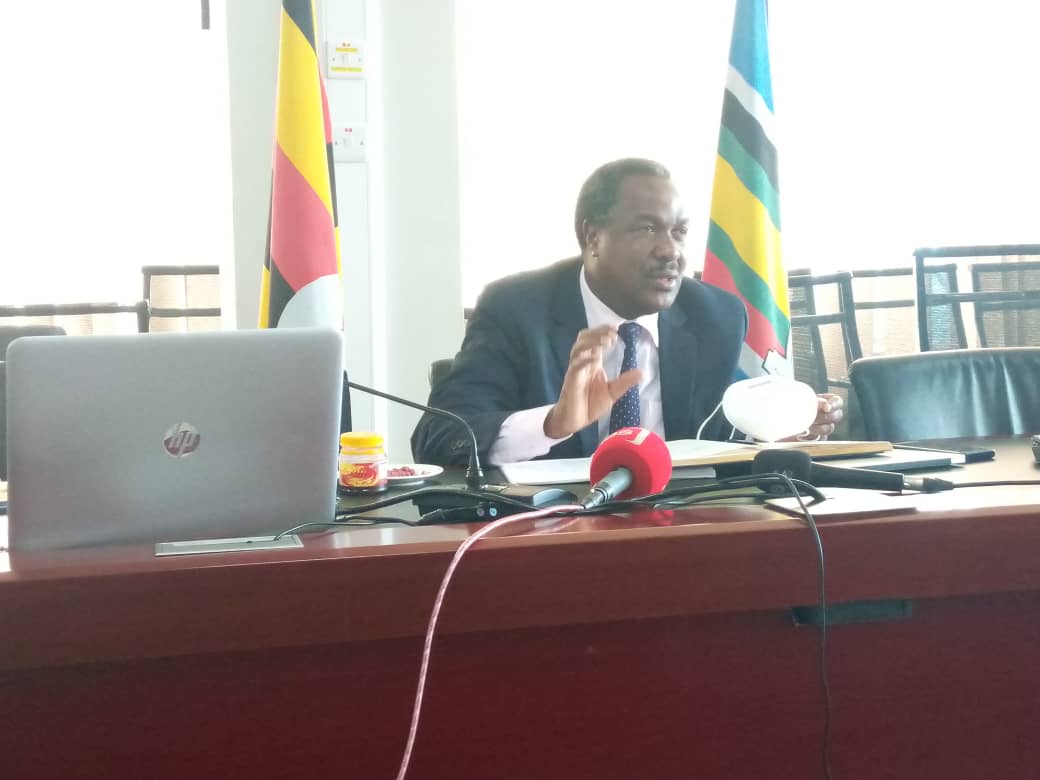
By Francis Otucu
A meeting by Specialized Technical Committee on Education, Science and Technology (STC-EST) on public health interventions held Thursday opines that COVID-19 is a new disease about which many things are still unknown.
However, Scientists have unraveled the coronavirus, the disease agent, with unprecedented speed and openness.
“COVID-19 pandemic is both a health crisis and a human tragedy. The COVID-19 pandemic is not like any other global health epidemic the world has faced in the recent times – both in terms of health, economic and social impacts and pace of spread The current COVID-19 pandemic has underscored the critical role science plays at the forefront of global responses to prevailing threats and challenges,” Hon. Dr. Elioda Tumwesigye (MP) Minister of Science, Technology and Innovation, Uganda, and (STC-EST) said.
Dr. Tumwesigye noted that Science, Technology and Innovation and especially research plays a central role in understanding the disease and generating new knowledge.
According to Dr. Tumwesigye, the COVID-19 crisis also has effectively anchored the role of science as a driver for evidence-based decision-making.
“Consequently, governments world over are referring to science to guide them in the measures taken in order to protect their nations, contain the spread of the virus and manage the pandemic. The rapid spread of coronavirus across the globe resulting in tens of millions infected and hundreds of thousands dead in a rapidly short time has led to skyrocketing of demand and running out of supplies for key medical consumables and devices needed to quickly diagnose and manage those with serious symptoms as well as protect healthcare workers, patients and the general public. This has exposed each individual country’s vulnerabilities and strengths,” he said.
His advice, is, however, that innovative countries can turn this challenge into an opportunity.
“Countries, both developed and developing, are in the rush to design and bring to market simple but effective alternative testing kits; protective gear for health workers, patients and the public; systems for tracing, tracking and managing those that may be in contact or in quarantine; and medical devices to manage those with serious symptoms of the coronavirus. For countries with a large industrial base and top research and innovation hubs, interdisciplinary teams can spend a day or two to develop safe and robust alternatives,” he noted.
He is, however, cognizant of countries in Africa that do not have the muscle to turn the effects brought about by the pandemic into an opportunity.
“Most countries in Africa do not have large industrial base backed by top research institutions nor deep financial resources to import all the supplies they may need. However, a number of research centres, universities and institutes as well as private entities and individuals are implementing similar efforts,” he said.
However, he said, “Linking them up with each other and with institutions that can provide technical and financial resources can boost their capacity to deliver. It can also help nurture creativity and innovation and turn such budding efforts into true innovation centres and potentially become birthplaces of strong industries for medical devices and health related supplies for the future.”
To Dr. Tumwesigye, there are still gaps in understanding coronavirus and its disease COVID-19.
“These include inter-alia; need to understand clearly the modes of transmission especially on the issue of airborne transmission by droplets or by aerosols, the mechanism by which asymptomatic people transmit the disease and policy, rationale and utility of compulsory use of cloths masks and with what level of viral particle filtration efficiencies. There is also need for more understanding on why the Virus appears to be spreading much more faster in USA, Europe than for example some parts of Africa and the factors that increase an individual’s risk of being infected with SARS-CoV-2, developing COVID-19 and the determinants of adverse outcomes after infection. It is hypothesized, for instance, that immunization with BCG (Against TB) confers some protection against severe pneumonia not onlycaused by bacterial pathogens of the respiratory tract but also by a broad range of other viral pathogens including SARS-CoV-2. Given the universal implementation of BCG vaccination in some parts of the World, it is important to assess vaccination histories of identified COVID-19 cases and the importance of BCG vaccination on influencing the risk of infection with SARS-CoV-2, developing COVID-19; the effects of the disease on the Respiratory System; and rate and speed of recovering from the disease,” he explained.
The control of the pandemic due to COVID-19 poses an immense global challenge. However, he said, the long-term implementation of effective control strategies such as social distancing may lead to social and economic cataclysm.
“Yet, discontinuing the measures too soon could lead to successive outbreaks that may be equally or more serious in terms of human cost. The current control archetype that is profoundly based on preventing infection with COVID-19 may not be easily sustained over a long period of time e.g. until when a vaccine and or effective drug is found. An additional paradigm relying on natural immunity to the virus also needs further elucidation. The basis of natural immunity is based on the fact that the human cost (severe disease or deaths) attributable to COVID-19 is hugely dependent on age and co-morbidities with non-communicable diseases. In the USA for example people above 65 years of age that make up only 16% of the population contribute 80% of mortality attributable to COVID-19. In the UK among the patients who died, the median age was 80 years and only 12% had no reported comorbidities. Therefore, a dual strategy for containment is needed to achieve a balance. More public health research is needed to study an approach to target population at low risk of severe disease (age below 65 years and without a health condition) for development of natural immunity and protection from infection among those vulnerable to severe disease (65 years and above with or without a health condition). This two-fold stratagy would have multiple merits such as plummeting prevalence of severe disease and death, aiming the most strict control measures to a low proportion of the population thereby making them more efficient and sustainable, reducing the chance of successive outbreaks and enabling the health systems to cope with the relatively small numbers of severe disease subsequent from low risk population,” he noted.
“We all know that no infectious disease can be successfully defeated without diagnostic test kits, medicines and or vaccines. I join others to appreciate the work of the European and Developing Countries Clinical Trials Partnership (EDCTP) and this needs to be strengthened. It is important that we conduct clinical trials in Africa as well and it is crucial that drugs and vaccines that may be developed will be accessible to Africa. It is also crucial that as Ministers of Research and Innovation support the translation of Research and Development outputs into commercialized outcomes. This requires not only technical capacity but also significant funding,” he offered.
On the Ugandan COVID-19 context, Dr. Tumwesigye gave a thumps up to President Yoweri Museveni for what he described a very strong, timely and appropriate COVID-19 Response informed by the best scientific evidence and public health knowledge known globally to ensure very slow entry of the virus into the country. “In Uganda we registered the first COVID-19 case in March, we now have 1043 cases with nearly 1000 recoveries and no deaths. We have put millons of dollars to support scientists and innovators to undertake research and develop diagnostic reagents, medicines and vaccines needed to effectively combat COVID-19,” he said.
INNOVATION FUND
During the STC-EST meeting in Addis Ababa in December 2019, the AU Ministers responsible for Education, Science and Technology agreed on the expeditious establishment of an Education Science and Technology Fund with support from the African development Fund. The ministers requested the AU Commission to combine the Africa Science Technology and Innovation Fund as well as the Education Fund into a single Education, Science, Technology and Innovation fund that will pave the way for “A Scientifically proficient and Technologically advanced Innovative African Society”.
According to Dr. Tumwesigye, this fund will contribute towards the improvement of Africa’s competitiveness in the 21st century, with skilled and well educated workforce, State-of the-Art and well equipped Laboratories to ensure that science can contribute to bringing solutions to the problems that Africa is facing including poverty, food insecurity and diseases particularly infectious diseases with more frequent and lethal disease outbreaks such as Ebola, Zika and the on-going Coronavirus epidemic.
“Innovation platforms hitherto localized and scanty will benefit from building the requisite infrastructure as well as from the linkages of universities and research institutions to business and the private sector for the African innovators to flourish and to provide for both employment generation and wealth creation indispensable for the attainment of the Africa we want, and the African dream. Through these investments, more opportunities will be provided to create enabling environments for the enormous number of young people in Africa to unleash their social, economic, cultural and intellectual potential and to engage more fully in contributing to Africa’s development into a knowledge-led economy,” he said.
According to Dr. Tumwesigye, Scientific and especially Health Innovation in Africa is on the rise, and momentum is building for new measures to strengthen and sustain the capacity of African Institutions including Universities and Research & Development (R&D) Cetres to become an effective force for economic growth and local solutions for health and development challenges. The STISA-2024, Agenda 2063, and the SDG compacts all point to a commitment for action, he said, adding, the discussion is timely.
“The time surely is ripe to support a decisive shift in the leadership, governance, and funding of African research and innovation—with the leaders of African public, private, and philanthropic organizations embracing ownership and informing priorities. I am very pleased to report to this esteemed meeting on a timely and innovative enterprise, focused on scientific capacity as a prime driver for development in Africa. I bring this initiative to your attention since it so closely aligns with the EU-AU Partnership objectives, as well as those of the Specialized Technical Committee on Education, Science and Technology. Over past months, the leadership of the African based Institutions together with the US National Institutes of Health, Welcome Trust, and Bill & Melinda Gates Foundation have initiated an enterprise known as the “Coalition for African Research and Innovation (CARI)” for which I was elected Chair of its independent Board two weeks ago. CARI is a novel partnership, focused on scientific capacity as a prime driver for development in Africa and to explore actions toward a strengthened, sustainable, and autonomous African biomedical research enterprise. Our collective aim is to create a stronger, more sustainable and autonomous African biomedical research enterprise. I have been delighted by the early enthusiasm and support for this formative initiative among African ministerial and corporate colleagues alike, at the World Economic Forum, and more recently at the annual Grand Challenges conference convened in Addis Ababa last October. CARI is a unique and influential coalition that is positioned to promote and advance African-led partnerships to drive innovation and job creation. To realize its bold yet achievable aims, CARI will advance incentives and strategies to encourage local and corporate investment, and public-private partnerships. In the coming months, CARI will move forward with a business plan informed by African thought leaders, conveying concrete and measurable objectives, readably convertible to implementation strategies. The coalition also will explore financing strategies and methods to leverage traditional and innovative capital for African-led biomedical R&D. The Coalition very much hopes to engage the leadership of the European Union Commission to support this Initiative,” he noted.
To this, he assured the meeting of the enthusiasm of the Specialized Technical Committee on Education, Science and Technology (STC-EST) to work with development partners, EU Commission towards the attainment of The STISA-2024, Agenda 2063 and the SDGs especially SDG 3: To ensure healthy lives and promote well-being for all at all ages whose target (3b) is to: Support the research and development of vaccines and medicines for the communicable and noncommunicable diseases that primarily affect developing countries, provide access to affordable essential medicines and vaccines, in accordance with the Doha Declaration on the TRIPS Agreement and Public Health, which afirms the right of developing countries to use to the full the provisions in the Agreement on Trade-Related Aspects of Intellectual Property Rights regarding fexibilities to protect public health, and, in particular, provide access to medicines for all.
“We welcome any support (technical and or financial) to support these budding R&D efforts,” he concluded.